
Online Solar Training and Renewable Energy Courses - Solar Energy International (SEI)
Currently there is only one course in this category and it is the AES O&M Course a.k.a. SEI's PVOL095: Introduction to O&M for Large-Scale PV Systems.
There are some slight differences between the AES Version and the SEI PVOL095 Version.
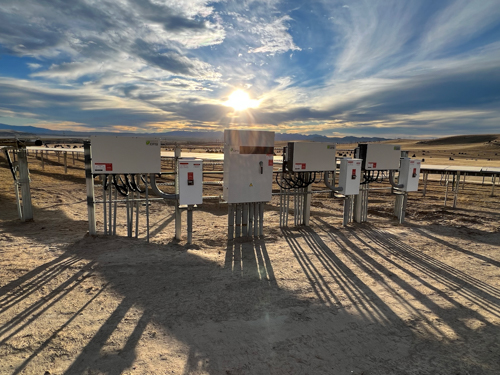
AES: Introduction to Large-scale PV for O&M Technicians
This course is an introduction to and overview of utility-scale PV and energy storage systems and is targeted toward entry-level technicians. Safety is a primary focus of this course, including assessing physical and electrical hazards, creating an electrically safe work environment, using disconnecting means and lock-out/tag-out (LOTO) to segment systems, personal protective equipment (PPE), and selecting and safely using electrical meters.
- Course Manager: Yasmin Abdulatheem
- Course Manager: Karo Fernandez - Instructor
- Course Manager: Janel Núñez
- Course Manager: David Rutland
- Course Manager: Cornelius Vanderbilt
- Teacher: Alex Hasty

AES: O&M Planning Considerations
- Course Manager: Yasmin Abdulatheem
- Course Manager: Karo Fernandez - Instructor
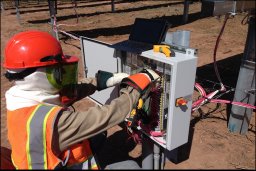
AES: Leading Visual Inspections
- Course Manager: Yasmin Abdulatheem
- Course Manager: Karo Fernandez - Instructor
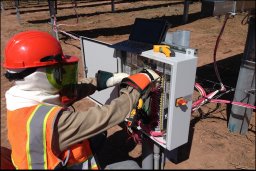
AES: Advanced PV Diagnostics: Thermal Imaging on PV
Thermal imaging has many uses in PV system O&M, both for preventive maintenance and as a troubleshooting tool. The fundamentals of thermography are the starting point; from there applications include imaging of terminations to look for high resistance and overheating, inspection of electrical equipment, and troubleshooting, followed by guidance from existing standards on how to respond to issues that are found.
Unique to our industry is using thermal imaging to inspect PV modules. Information can be obtained rapidly, and in fact aerial thermography – either via drone or human-piloted aircraft – has become a preferred means of inspecting PV arrays on large systems, dramatically reducing the time spent on the ground trying to find issues through other means. Hand-held use, while difficult at a large scale, is particularly useful for pinpointing issues and troubleshooting. Typical failures and their heat signatures are a key takeaway, as well as recommended actions based on severity.
- Course Manager: Yasmin Abdulatheem
- Course Manager: Karo Fernandez - Instructor
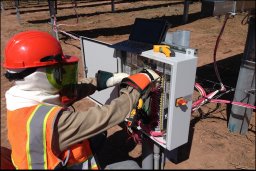
AES: Advanced PV Diagnostics: Troubleshooting & Ground Faults
Troubleshooting is a skill and an art; it takes patience and perseverance, knowledge and resourcefulness. It also requires attention to the fact that something is wrong, and as such additional hazards may exist; and figuring it out often means working on energized circuits, so a clear mind, standard operating procedures, and the correct PPE are all necessary too.
There are lots of different failures that can happen, some are specific to PV systems, some are common to electrical systems in general; a range of issues will be covered, focusing in particular on ground-faults, one of the most common problem O&M providers face.
- Course Manager: Yasmin Abdulatheem
- Course Manager: Karo Fernandez - Instructor
AES: Advanced PV Diagnostics: I-V Curves
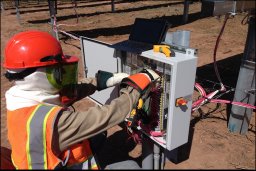
I-V curves are the basic graphical representation of performance of PV cells, modules or strings: measuring them can allow for insights into performance issues that are difficult, if not impossible, to see with other means. While field-use of I-V curve tracing has been in decline, it is still commonly used and – even if you never use an I-V curve tracer – being able to "think like a module," will help you immensely in troubleshooting, determining the root cause of issues spotted through other means, and in understanding why PV "acts" the way it does.
This lesson starts with the basics of I-V curves, addresses field use of tracers, and quickly builds to an advanced discussion of good, bad, and ugly curves, what they mean, and what causes them. This is critical information for the well-rounded O&M professional.
- Course Manager: Yasmin Abdulatheem
- Course Manager: Karo Fernandez - Instructor
AES: Advanced PV Diagnostics: Insulation Resistance Testing on PV
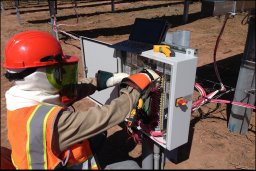
Insulation resistance testing, or IRT, is akin to pressure testing a water line: applying a voltage to a conductor and seeing if there is any path for current to a different conductor, or to ground. Specified as a commissioning test for PV systems by the International Electrotechnical Commission (IEC), IRT may also be required as preventive maintenance in cases – contractually, by equipment manufacturers, or both.
Additionally, insulation resistance testing is a valuable tool for locating ground-faults. IRT concepts, theory, execution, and evaluation of results are covered in this lesson.
- Course Manager: Yasmin Abdulatheem
- Course Manager: Karo Fernandez - Instructor